For most beginners, piano and ukulele are the easiest instruments to start on, with guitar and voice close behind. Piano is easy to begin because every note is already in tune and laid out in a straight line. Ukulele has only four soft nylon strings and simple chord shapes, so beginners play songs within days. “Easiest” depends on what you want from the first few months, though, and the instrument that excites you will always feel easier than the one that looks simple on paper.
What makes an instrument easy to start
A few factors decide how friendly an instrument feels in the beginning:
- How quickly it sounds good. Some instruments sound pleasant on day one. Others squeak for months.
- Physical comfort. Soreness, awkward posture and the strength needed to produce a note all slow beginners down.
- How visible the notes are. Seeing patterns helps you understand what you are doing.
- How much the player controls tuning. Instruments with frets or keys take that job off your plate.
By those measures, here is how the common choices compare.
Piano: the easiest to understand
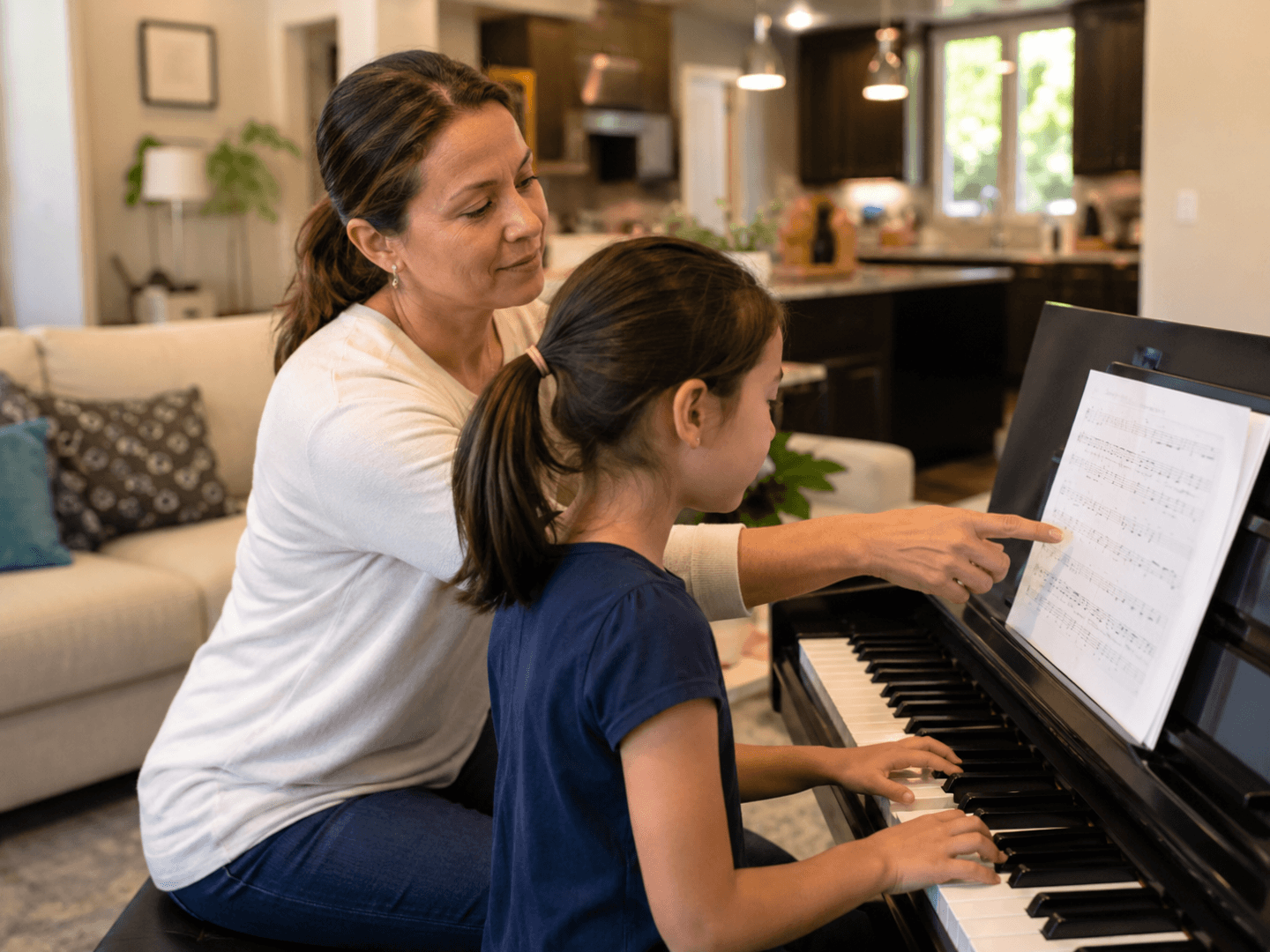
Press a key and you get a clean, in-tune note. The keyboard shows the whole system of Western music at a glance, so scales and chords make visual sense. Beginners of any age can play simple melodies in the first lesson, and children as young as 5 handle it well.
The challenge comes later, when the left and right hands play different parts. Still, piano gives a strong foundation for reading music and theory that helps with every other instrument.
Ukulele: the easiest to play songs on
A ukulele weighs about as much as a hardcover book, and its nylon strings barely bother your fingertips. The C chord takes one finger. A beginner who learns C, A minor, F and G can already strum through a surprising number of campfire favorites and kids’ songs in the first week or two. That instant payoff is why parents of six-year-olds and retirees alike often pick it up first, and why some of our students treat it as a warm-up before moving to guitar.
Guitar
The first few weeks of guitar are a bit rough, with sore fingertips and slow chord changes. Once you get past that, a handful of chords covers a huge number of songs. Teens and adults who want to play the music they already listen to often find guitar the most motivating choice.
Voice
You do not need to buy anything to sing, and you can practice in the car or in the shower. Getting better depends on training your ear and your breathing, and some beginners feel shy about singing in front of someone at first. Children usually start formal voice lessons at about 7.
Violin
Violin is not the easy option. There are no frets to show where the notes are, and the bow needs a lot of practice before it stops squeaking. The families we see choose it because they love how it sounds, and that is usually enough to get a child through the first year. If you are comparing it with piano, see whether violin is harder than piano.
With children around 5 to 7, piano tends to be the simplest place to begin because nothing needs tuning. A small guitar or a ukulele is fine too. Violin can start at 5 with a properly sized instrument, and for voice we usually wait until about 7.
Easiest for adults
Adults usually do best with piano, guitar or ukulele, depending on their goals. If you want to accompany yourself singing, choose guitar or ukulele. If you want to understand music deeply or play solo pieces, choose piano.
Does “easy” matter that much?
Less than you might think. Motivation beats difficulty. A child who begs for violin will practice it more willingly than a piano they were steered toward. For more help deciding, see our earlier guide on choosing a first instrument for your child.
Try an instrument in Sugar Land
Century Fine Arts offers private lessons in piano, guitar, violin and voice for children, teens and adults. Not sure which to pick? Book a free 15-minute trial and try one, or call 832-400-5980 to ask which suits your goals.