
For most beginners, violin is harder than piano in the first year or two. On piano, pressing a key gives you a correct, in-tune note every time. On violin, you create the pitch yourself by placing a finger on a string with no frets to guide you, while your other arm controls the bow’s speed, weight and angle. That is why a first-year violinist often sounds scratchy while a first-year pianist already sounds pleasant. Over the long run, both instruments are equally deep, and many teachers would say advanced piano repertoire is every bit as demanding.
Why violin is hard at the start
Violin asks for several new skills at once, and none of them is automatic.
Intonation. A millimeter can make a note sound sharp or flat. Beginners spend months training their ears and fingers to land in the right spot. Some teachers place small tapes on the fingerboard as guides at first.
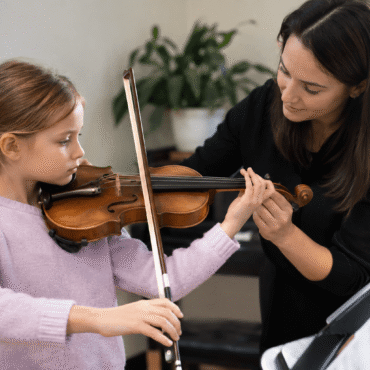
The bow is the other big challenge. Keeping it straight, at an even speed, with the right weight and at the right distance from the bridge takes years to master. Too little weight gives a thin, airy sound and too much gives a crunch. When you hear a beginner squeak, the cause is usually the bow arm rather than the fingers on the strings.
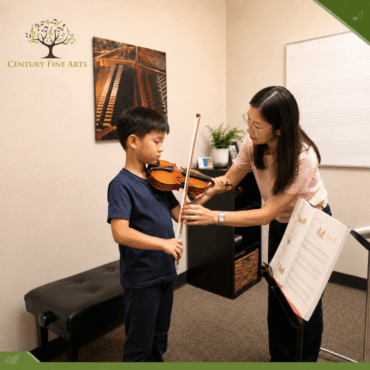
Posture. Holding the violin under the jaw with a relaxed left arm and a loose bow hand feels awkward for weeks. Tension creeps in easily.
Put together, these explain why violin students need patience early on. The payoff is an excellent ear and a strong sense of pitch.
Why piano is easier at the start
Piano removes several of those challenges. Every note is already tuned. Sound comes from simply pressing a key, so beginners can focus on reading, rhythm and finger patterns. The layout is visual, making it easier to see scales and chords.
Many piano beginners are playing short pieces that sound like real music within a few months, and that helps them stay interested.
When piano gets harder
On piano the difficulty comes later, with coordination and the amount going on at once. You read two staves together, the hands often play melody and accompaniment at the same time, and further on there is pedaling and big jumps across the keyboard. A violinist usually plays one line. A pianist is responsible for all the parts.
So the honest comparison is this: violin is harder to sound good on early, piano becomes more complex to coordinate as music gets advanced.
Which is better for a child?
Both are wonderful first instruments. Piano gives quick early wins and a strong foundation in reading music and theory. Violin builds a remarkable ear and fits children who love string sounds, orchestras or fiddle music. We recommend that kids begin violin lessons around age 5, with an instrument sized to their arm length. Our guide on when to start violin covers readiness in more detail.
Patience is the main difference for parents. A violin household should expect a few months of squeaks before the music settles in. A piano household usually hears recognizable tunes sooner.
Which is better for adults?
Adults who pick violin usually do it because they love how it sounds, and that helps them get through a slow first year. Adults who pick piano get quicker early results and can play complete pieces on their own. Both are realistic choices if you have a good teacher and practice a little every day.
Does learning piano first help with violin?
It can. Piano teaches reading, rhythm and theory, which make violin music easier to understand later. But it is not required. Many violinists start on violin and add piano afterward. The best first instrument is the one that excites the student enough to practice.
Try violin or piano lessons in Sugar Land
Century Fine Arts teaches private violin and piano lessons for children, teens and adults. If you cannot decide, try both. Book a free 15-minute trial or call 832-400-5980.