
Yes. Almost anyone can learn to sing in tune with good instruction and regular practice, including people who have been told they are tone-deaf. True tone deafness, a condition called congenital amusia, is rare. Researchers usually estimate it affects only a small share of the population, often cited as somewhere around 1.5 to 4 percent. Most people who think they cannot sing simply have not trained the connection between what they hear and what their voice does.
That connection is a skill, and skills improve with practice.
Why some people sing off-key
Singing in tune depends on three things working together: hearing a pitch accurately, knowing how your own voice feels when it matches that pitch, and controlling the muscles that produce it. When someone sings off-key, the problem is rarely the ears alone. More often the voice has never been coordinated with the ears.
Think of it like throwing a ball at a target. You can see the target perfectly well, but your arm still needs practice to land the throw. Singing works the same way. Many adults who struggle with pitch can tell right away when a recording of someone else is out of tune. Their ears are working fine.
Other common causes include:
- singing in a range that is too high or too low for your voice, which makes every note feel like a stretch;
- tension in the jaw, tongue or neck that pulls pitch off target;
- shallow breathing that leaves the voice shaky;
- simply never singing, so the voice has no practice at matching sounds.
How to tell if you might be tone-deaf
Ask yourself a few honest questions. Can you tell when a familiar song is played with a wrong note? Can you hear the difference between a happy tune and a sad one? Do you notice when a singer on the radio goes flat? If the answer is yes, your hearing is probably fine, and your voice needs training.
Online pitch-discrimination tests can give a rough idea, but a voice teacher will usually figure it out within a few minutes by playing notes and asking you to match them.
What voice lessons do for pitch
A good teacher does not start with big songs. Early lessons usually focus on:
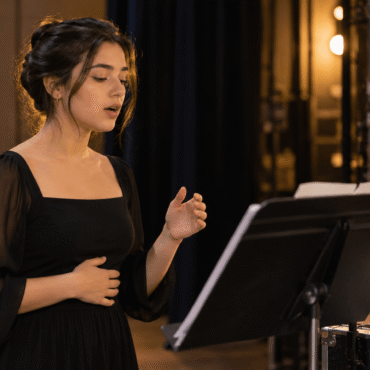
Lessons for this usually start with pitch matching. The teacher plays or sings one note, you try to match it, and then you slide between two notes so you can feel the change. A teacher will also help you find the range where your voice is comfortable, because many people who think they sing badly have simply been singing songs written for a higher or lower voice. Steady breathing and a relaxed jaw and neck help a lot with tuning, and some lesson time goes to listening, such as hearing the distance between two notes.
Improvement can come quickly. A student who cannot match a single note at the first lesson may be singing simple songs in tune a couple of months later. Others need more time, but steady progress is what usually happens.
Practicing at home
You do not need long practice sessions. Five or ten minutes a day is enough to start. Hum along with a keyboard or a piano app, using notes in the middle of your range. You can also record a short phrase, play it back and compare it with the original, or sing along with a recording you like and then sing the same part without it to see whether you stay in tune.
Be patient and kind to yourself. Embarrassment is the biggest obstacle for adult singers. A lesson is a safe place to sound unpolished, and every confident singer once sounded unsure.
Is it ever too late to learn to sing?
No. The voice changes with age, but adults of any age can improve pitch, tone and confidence. Children usually start voice lessons around age 7 or later, and there is no upper limit. We wrote more about the benefits in why everyone should learn to sing.
Try a voice lesson in Sugar Land
If you have always wanted to sing but worried you could not, a short lesson is the easiest way to find out. Century Fine Arts offers private voice lessons for kids, teens and adults, and the 15-minute free trial is a low-pressure first step. Book your trial online or call 832-400-5980. You might be surprised by what your voice can do.