Music theory is the explanation of how music works. It covers how notes are named and written down, how rhythm is counted, how scales and chords are put together and why some sounds feel finished while others feel like they need to go somewhere. You do not have to learn theory before you start playing. Studying it while you learn an instrument, though, makes reading quicker, memorizing easier and practice time more useful. A lot of teachers compare it to grammar. People speak long before they study grammar, but knowing it helps when you read and write.
What theory includes
For most students, theory begins with the basics they need right away. That means reading notes on the staff in treble and bass clef, ledger lines and key signatures, and counting rhythm with note values, rests and time signatures. After that come major and minor scales and how keys relate to each other, intervals (the distance between two notes), chords and common chord progressions, and finally form, which is how a piece is put together with verses, choruses and repeats.
Later, theory expands into analysis, composition and arranging, but a beginner only needs the first few layers to see big benefits.
Do students really need it?
You can play music without formal theory. Plenty of guitarists strum by ear, and many singers learn songs from recordings. But students who skip theory entirely tend to hit a ceiling. They struggle to read new music, rely on memorizing note by note and have a hard time figuring out why a passage is difficult.
In our experience, students who study theory along with their instrument read new music faster, because scales and chords start to look familiar on the page. They tend to memorize pieces more reliably too, since they understand how the piece is built instead of remembering a long row of notes. Practice gets easier when a hard passage turns out to be “just an F major arpeggio.” Later on, theory also makes it easier to transpose, improvise and play by ear.
Theory on different instruments
Pianists have an advantage here, because scales, chords and key signatures are laid out on the keyboard where you can see them. Violinists use theory to hear intervals and to understand how a key signature changes where the fingers go.
On guitar, knowing how chords are built turns memorized shapes into a system. Students start to understand why G, C and D fit together, and how to move a shape up the neck.
For singers, theory and ear training help with sight-singing, harmony parts in choir and learning music quickly for auditions.
Ear training: theory you can hear
Ear training is theory for your ears. It teaches students to recognize intervals, chords and rhythms by sound, sing back melodies and notice when something is out of tune. Methods like solfège, the do-re-mi system, are a classic way to build this skill. We wrote about it in the value of solfège for all musicians.
When should students start theory?
Right away, in small doses. A first-year student learns note names, basic rhythms and a scale or two as part of their pieces. Formal theory classes become especially valuable once students are reading confidently, often after the first year. Texas students preparing for auditions, honor ensembles or college music programs benefit from deeper study as they get older.
Does theory take the fun out of music?
Not when it is taught well. Good theory instruction connects directly to the music a student is playing. Discovering that a favorite pop song and a Mozart piece use the same chord progression can be genuinely exciting.
Theory classes at Century Fine Arts
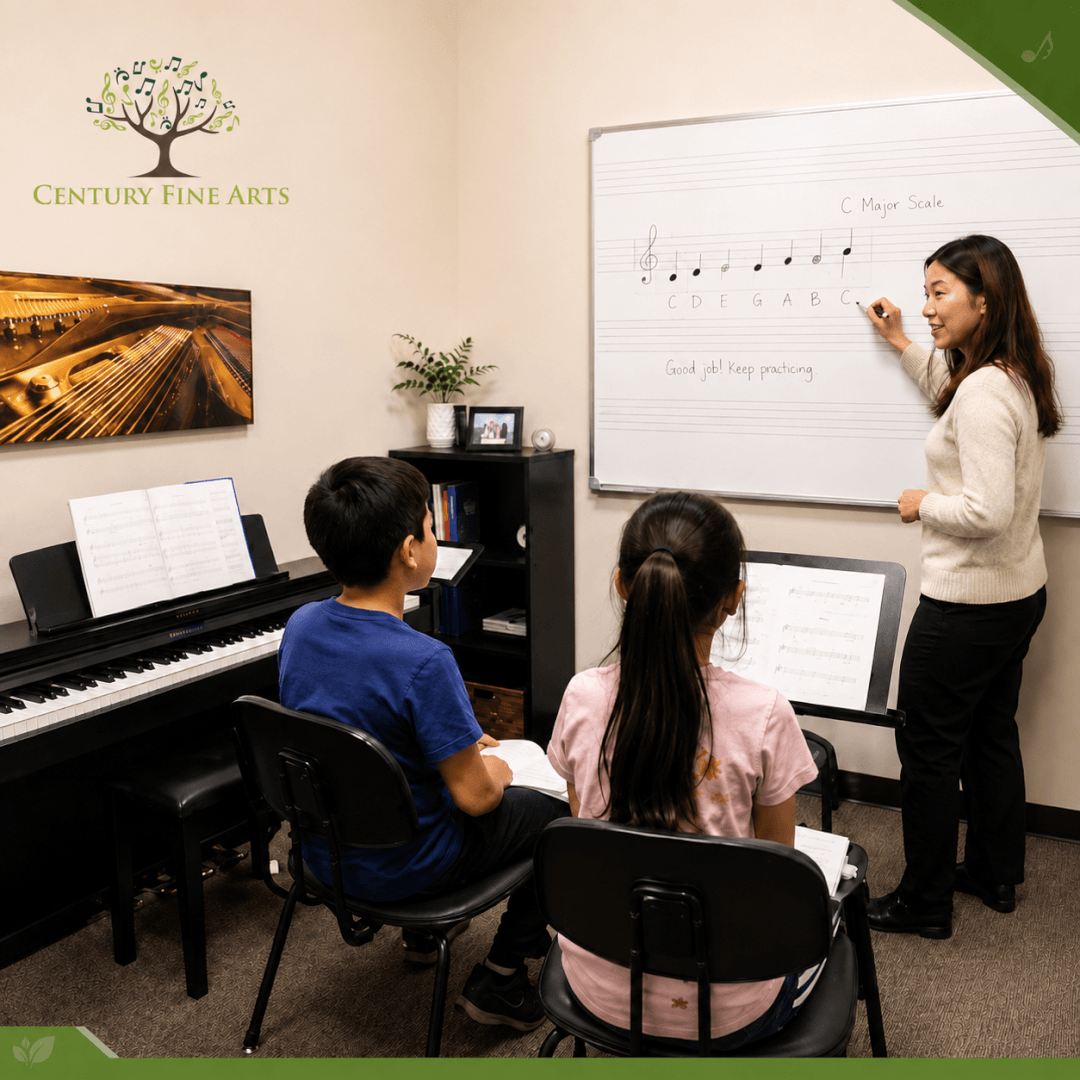
At Century Fine Arts, students in private lessons are offered ear training and theory classes as part of their tuition, alongside chances to perform in recitals. That means students build reading and listening skills without paying separately for another program.
Interested in piano, violin, guitar or voice? Book a free 15-minute trial lesson in Sugar Land or call 832-400-5980.