Violin takes patience. With weekly lessons and regular practice, most beginners play simple tunes like “Twinkle, Twinkle” and “Lightly Row” with a reasonably steady tone within three to six months. Sounding consistently pleasant, in tune and confident on beginner pieces usually takes one to two years. Reaching an intermediate level, with shifting between positions and vibrato, is commonly a three- to five-year journey. Adults sometimes move faster through the early material because they understand instructions quickly, while young children gain ease in the hands over time.
Instead of a month-by-month list, it is more useful to think about violin in stages, because each stage has its own big hurdle.
Stage one: making a sound you like
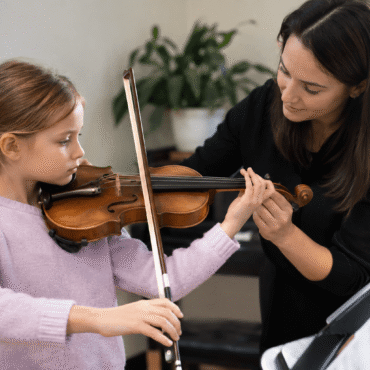
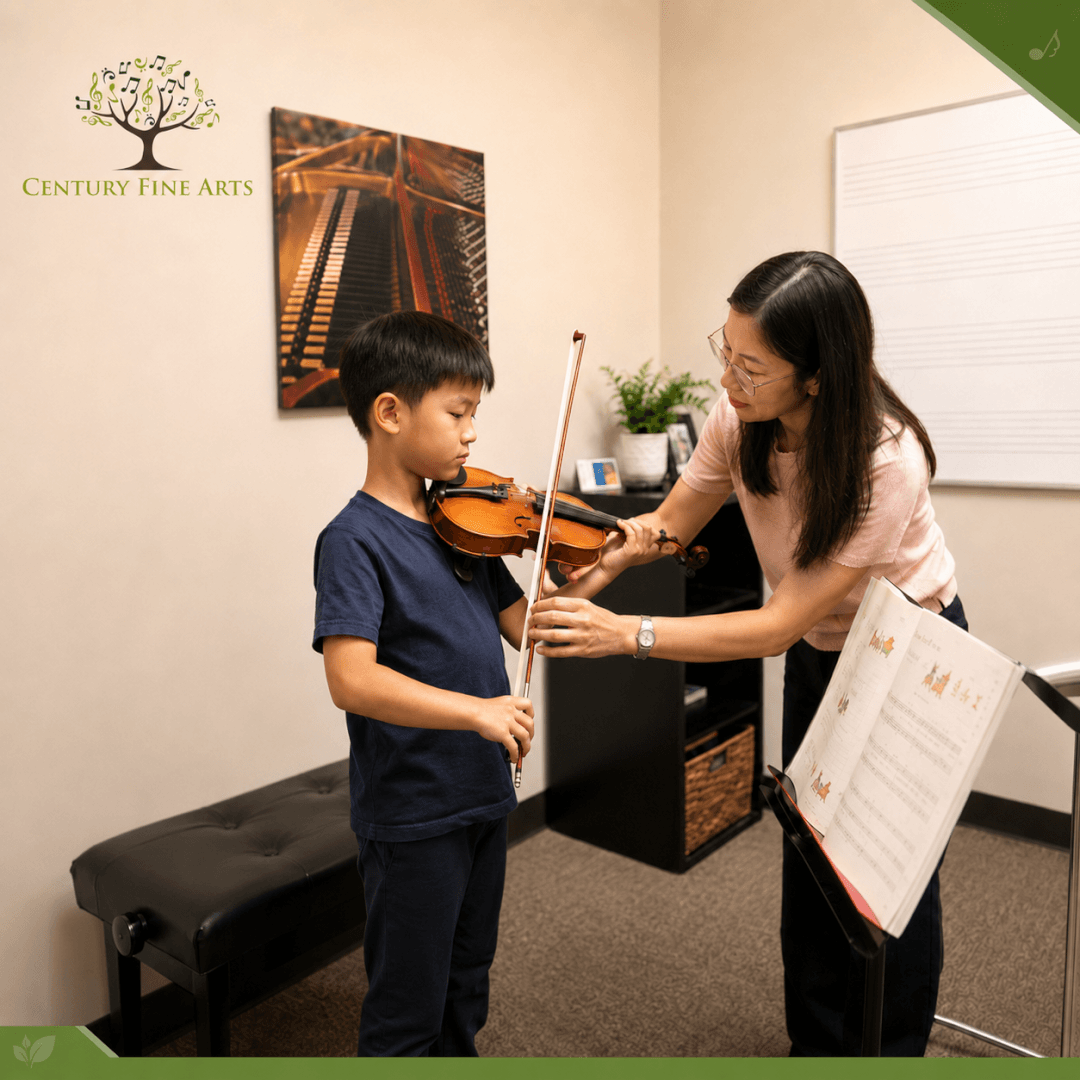
The first weeks are about posture and the bow. Students learn to hold the violin with the jaw and shoulder rather than gripping it with the left hand, and to hold the bow with a soft, curved thumb. Most of the music is on open strings, so the focus stays on drawing a straight bow with even pressure.
Parents sometimes find this part slow, since they mostly hear the same note again and again. It is still the most important stage. A student who learns a relaxed bow arm now will sound better at every level later on.
Stage two: fingers and first songs
After that, the student starts putting left-hand fingers on the strings, usually in first position. Many kids play the “Twinkle” variations and simple folk songs from Suzuki Book 1 or something like it. Now the hard part is staying in tune, since there is nothing on the violin to show exactly where a note is. Some teachers use small strips of tape on the fingerboard for a while as a guide.
At the end of this stage a student can usually play a few short pieces, either from memory or from simple notation.
Stage three: reading and coordination
In the first and second years, students learn to read music comfortably, play slurs and cross between strings, and handle quicker rhythms. Bach minuets and easy fiddle tunes are typical pieces. As the bow arm develops, the sound gets fuller, and this is often when students join a school orchestra or play in a recital.
Stage four: shifting and vibrato
Somewhere in years two to four, students start moving up the fingerboard to third position and higher, and they begin working on vibrato. Both take months to feel natural, and they are a big part of what makes a violin sound grown up. At this point a student can play a lot of intermediate music, for example Vivaldi concertos or film themes.
What helps progress
Practicing a little most days works much better than long sessions now and then. For a young child, 10 to 15 minutes on most days is a good start. Older students gradually work up to 30 minutes or more.
Listening helps too, more than many families expect. If a student hears recordings of their pieces in the car or over breakfast, they have a clear idea of how the music should sound.
A properly sized and adjusted instrument removes a lot of friction. Our violin size guide and post on renting or buying a violin explain what to look for.
Finally, early private instruction prevents habits that are hard to undo later, such as a locked wrist or a tight bow grip.
Is violin slower to learn than other instruments?
Usually, yes, at least for the first year. There are no frets or keys to guarantee the pitch, and bow control takes time. We compared it directly in is violin harder than piano. The upside is a sharp ear and a skill that opens the door to orchestras, chamber groups and fiddle jams.
When does it start to sound good?
Many families hear a change somewhere between six months and a year. The squeaks get rare and simple pieces start to sound like music. A first recital is often a nice moment to notice how far a student has come.
Violin lessons in Sugar Land
Century Fine Arts teaches private violin lessons for children, teens and adults, and we recommend kids begin around age 5. Private-lesson tuition includes ear training and theory classes and chances to perform in recitals.
Book a free 15-minute trial or call 832-400-5980. We are at 3527 Hwy 6 S., Suite 220, in Sugar Land.