Yes, you can teach yourself guitar, and plenty of people pick up their first chords from videos and tab sites. The part that is hard to get on your own is feedback. Nobody tells you that your wrist is tense, that your timing drifts or that a habit will hold you back later. A teacher helps you improve faster, catches those problems and gives you a plan for the weeks when motivation is low. Which route makes sense depends on your goals, how disciplined you are and how fast you want to get better.
What you can learn on your own
There is a lot of free material now. On your own you can learn open chords and strumming patterns from video lessons, find tabs for nearly any popular song and use apps that listen to you and tell you whether a note was right. You can also practice whenever you have time, and it costs nothing.
For someone who wants to strum a few songs around a campfire, this can be enough.
Where self-taught players usually get stuck
Technique problems. Pressing too hard, a thumb wrapped too far over the neck or a collapsed wrist are hard to notice on your own. They make playing tiring and can slow progress for years.
Rhythm. Many self-taught players learn where the chords go but not how to keep steady time. Songs sound “almost right” without the player knowing why.
No clear path. With endless videos, it is easy to jump from topic to topic. Players often learn twenty song intros and never finish a full song or build skills in order.
The plateau. After the first few months, progress often stalls. Without someone to diagnose the cause, many players quit at this point.
Fingertip pain. Every beginner goes through sore fingertips. A teacher can tell normal soreness from technique that is making it worse. More on that in why your fingers hurt when you play guitar.
Why a teacher helps
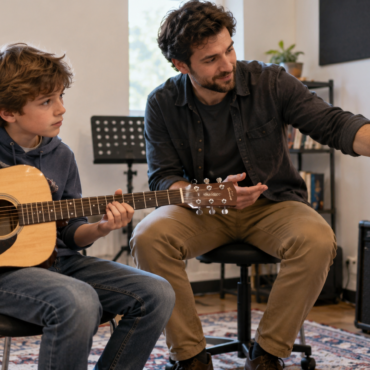
The biggest thing a teacher gives you is someone watching. A tight grip or a wrist bent the wrong way is easy to fix in the second week and annoying to fix two years later. Lessons also go in order, so you are not jumping between random videos, and the teacher can pick songs that are a bit hard but still doable. Having a lesson every week is a good push to practice, too.
Children and adults
Lessons matter more for children. Most kids will not organize their own practice for long, and getting the right guitar size and string type makes a big difference for small hands. See what size guitar your child needs and nylon or steel strings for kids.
Adults can manage more on their own. Still, many of our adult students like having a lesson for technique and then learning extra songs from videos at home.
Trying both
If you cannot decide, start with a few lessons to get your posture, grip and practice routine set up, and keep learning songs on your own between lessons. Bring questions and tricky spots to the teacher, and after a couple of months, decide what is working.
This gives you the freedom of self-teaching with a safety net for technique. For realistic expectations on progress, read how long it takes to learn guitar.
Guitar lessons in Sugar Land
Century Fine Arts offers one-on-one guitar lessons for kids, teens and adults, available Monday, Tuesday, Thursday and Friday. Our guitar coaches work with students from about age 5 to 50 and beyond, and lessons are shaped around the music you want to play.
See our guitar lessons or book a free 15-minute trial. Questions? Call 832-400-5980.