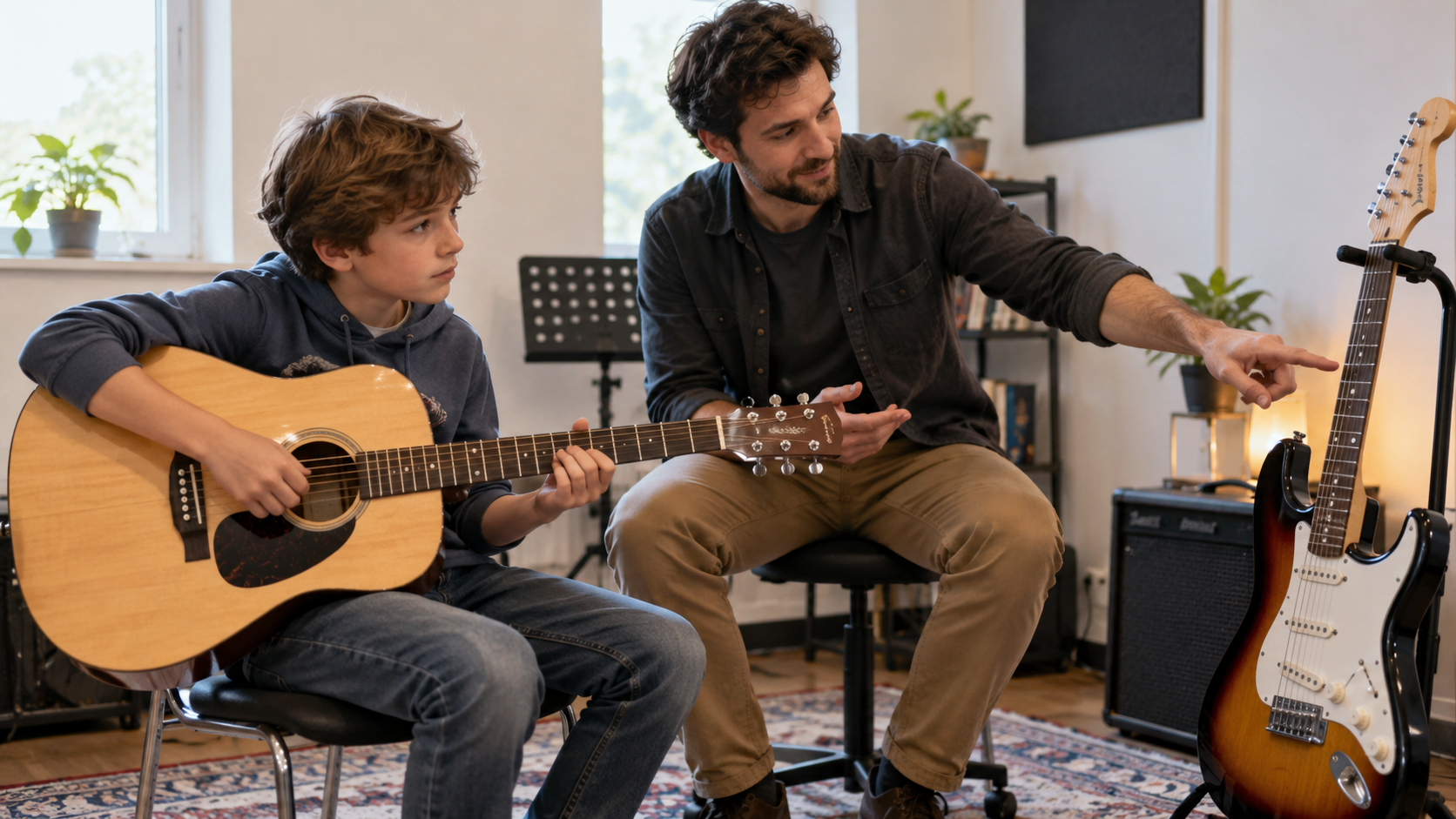
Should a Beginner Start on Acoustic or Electric Guitar?
A beginner does not have to start on an acoustic guitar before moving to electric.
That old rule gets repeated a lot, but the better first guitar is usually the one that fits the student physically, matches the music they actually want to play, and makes them want to pick it up again tomorrow.
For some beginners, that will be an acoustic guitar. For others, electric is the better starting point.
If you are choosing a first guitar for your child, here is what actually matters.
Start With the Music the Student Wants to Play
Before comparing strings, necks, amplifiers, or guitar sizes, ask one simple question:
What kind of music made the student interested in guitar in the first place?
A child who wants to strum songs, sing along, or enjoys acoustic pop and folk music may feel naturally drawn to an acoustic guitar.
Someone who became interested because of rock riffs, electric blues, lead guitar, or distorted guitar sounds may be much more excited by an electric.
That motivation matters.
A technically sensible guitar that a student rarely wants to play is not necessarily a better beginner instrument than one that makes them excited to practice.
Is an Acoustic Guitar Better for Beginners?
An acoustic guitar has one major practical advantage: simplicity.
You can pick it up and play. There is no amplifier to connect, no cable to plug in, and no additional equipment required just to hear the instrument properly.
That makes acoustic guitar convenient for practice at home.
It can also be a natural fit for students interested in:
- basic chords
- strumming
- accompanying songs
- singer-songwriter music
- folk
- acoustic pop
- fingerstyle playing
But acoustic does not automatically mean easier.
Many steel-string acoustic guitars require a beginner to press the strings firmly enough to produce a clean note. A large acoustic body can also feel uncomfortable for a smaller child.
That does not make acoustic guitar a bad choice. It simply means size and setup matter.
Is Electric Guitar Easier to Play?
An electric guitar can actually feel easier under the fingers for some beginners.
Electric guitars often use lighter strings, and the strings can sit closer to the fretboard depending on the instrument and its setup. That may require less finger pressure when a beginner is learning notes, chords, and simple riffs.
The body is also thinner than a typical acoustic guitar, which some students find comfortable while sitting.
But electric guitar introduces extra equipment.
A basic setup normally includes:
- the guitar
- an amplifier
- an instrument cable
- a tuner or tuning app
- picks if the student uses them
Depending on the amplifier, headphones may also be useful for quieter practice.
So electric can be physically comfortable to play, while acoustic can be simpler from an equipment standpoint.
Neither advantage automatically makes one guitar better.
What About Finger Pain?
New guitar players often notice tenderness in their fingertips when they first start pressing strings.
That can happen with both acoustic and electric guitar.
Steel-string acoustic guitars may require more pressure than many electric guitars, so some beginners notice the difference immediately. But the guitar itself is only part of the equation.
String gauge, instrument setup, technique, and how long the student practices at one time can all affect comfort.
Pain should not be treated as proof that a student needs to “tough it out.”
A beginner should learn how much pressure is actually necessary to produce a clear note. Pressing far harder than needed only creates unnecessary tension.
Good technique becomes especially important at this stage.
For Children, Guitar Size May Matter More Than Acoustic vs. Electric
For a young student, the most important question may not be acoustic or electric.
It may be:
Can the child comfortably hold and play this particular guitar?
A guitar that is too large can make basic technique harder than it needs to be. The student may struggle to reach around the body, position the fretting hand comfortably, or maintain a relaxed playing position.
Smaller instruments can make the first stages of learning much more manageable.
This is particularly relevant for younger beginners. Century Fine Arts notes that smaller-sized guitars are available for early starters, which can help families explore an instrument that better fits the student’s size.
The goal should not be to buy a guitar that a child will eventually grow into if the instrument is uncomfortable to use right now.
The first instrument needs to be playable now.
Acoustic vs. Electric: A Simple Comparison
Acoustic guitar may make more sense if:
- the student likes acoustic songs and strumming
- they want a simple instrument without an amplifier
- portability matters
- they enjoy singer-songwriter, folk, acoustic pop, or similar styles
- the guitar feels physically comfortable
Electric guitar may make more sense if:
- the student is primarily interested in rock, blues, riffs, or lead guitar
- lighter-feeling strings make playing more comfortable
- an amplifier and cable are not a problem
- volume control or headphone practice is useful
- the sound of an electric guitar is what motivates the student to learn
Neither list is a rule.
There are acoustic players who play complex lead parts and electric players who spend most of their time playing chords.
The important point is to choose according to the student, not according to a tradition that says every guitarist must begin the same way.
Don’t Choose a Guitar Only Because It Is the Cheapest
A first guitar does not need to be expensive.
But price should not be the only consideration.
An instrument that is difficult to keep in tune, uncomfortable to hold, or badly set up can make a beginner think they are the problem.
Sometimes the guitar is simply making the job harder.
Before purchasing an instrument for a child, pay attention to:
- physical size
- neck comfort
- string height
- tuning stability
- overall condition
- whether the student actually likes the instrument
A properly fitting beginner instrument is usually more useful than buying something based only on appearance or price.
Lessons Can Help Before Bad Habits Become Comfortable
Apps and videos can demonstrate chords and songs, but beginners often cannot see what they are doing incorrectly.
A wrist may be too tense.
A thumb may be in an awkward position.
A chord might buzz because one finger is touching a neighboring string.
The student may simply be pressing much harder than necessary.
Individual feedback can catch those small problems early.
At Century Fine Arts’ private guitar lessons in Sugar Land, instruction is one-on-one, allowing lessons to follow the student’s level, pace, musical interests, and goals. Students may work on areas including chords, rhythm, technique, music reading, songs, and basic theory.
That individual approach is useful because two beginners can start at the same time and need very different things from their first lessons.
What If You Haven’t Bought a Guitar Yet?
Do not feel pressured to make a rushed decision simply because lessons are about to begin.
Think about the student’s musical interests first.
Then consider their age, physical size, and which guitar feels comfortable.
For a child, this is especially important. A smaller guitar that fits properly may be a much better learning tool than a full-size instrument chosen only because it looks like the guitar they may use several years from now.
If possible, get guidance before committing to an instrument that does not feel right.
So Which One Should a Beginner Choose?
There is no universal winner.
Choose an acoustic guitar when the student likes the acoustic sound, wants a simple practice setup, and feels comfortable holding and playing the instrument.
Choose an electric guitar when electric music is what inspires the student, the instrument feels easier to play, and having an amplifier is not a problem.
For a child, add one more requirement:
Make sure the guitar actually fits.
A beginner is much more likely to keep learning when the instrument feels manageable and the music feels relevant.
For families exploring guitar lessons in Sugar Land, you can learn more about Century Fine Arts, review the school’s private guitar lesson options, or view Century Fine Arts on Google Maps.
The best first guitar is not automatically acoustic or electric.
It is the one that gives the student a comfortable, motivating place to start.