by Sean Stone-Ashe
If you are eager to become a better musician, you have the power to drastically improve your performance results and overall confidence through goal setting. In this article, I will discuss goal setting on a daily basis in your practice.
Yes, it is important to have long-term goals you are steadily working on, but this article is about how to set small and frequent goals within a single practice session to maximize your time and results.
- Maintain a Schedule with Strict Timekeeping
One of the first ways to increase your productivity in the practice room is to develop a daily schedule. This means not only committing to practice your music daily, but also to manage your time effectively within that practice time by creating a schedule of your practice time.
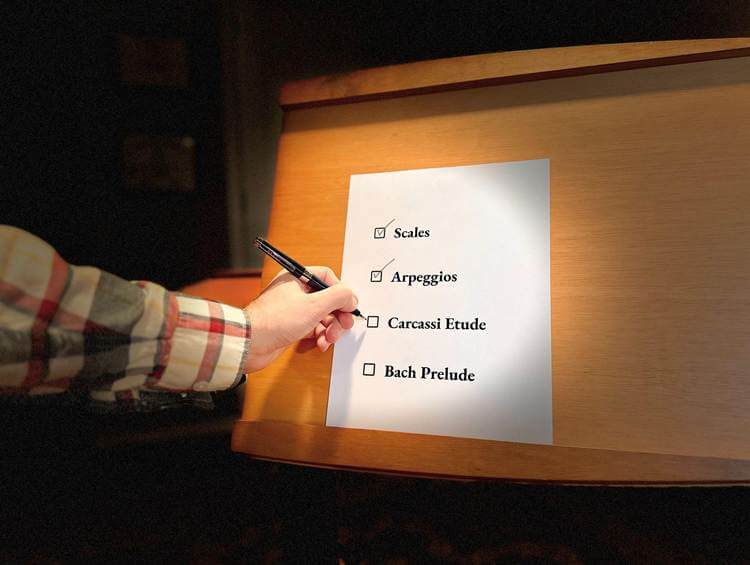
Let’s assume you spend 30 minutes every day practicing. If you take that half-hour block and divide it into different components, you can use your time more effectively.
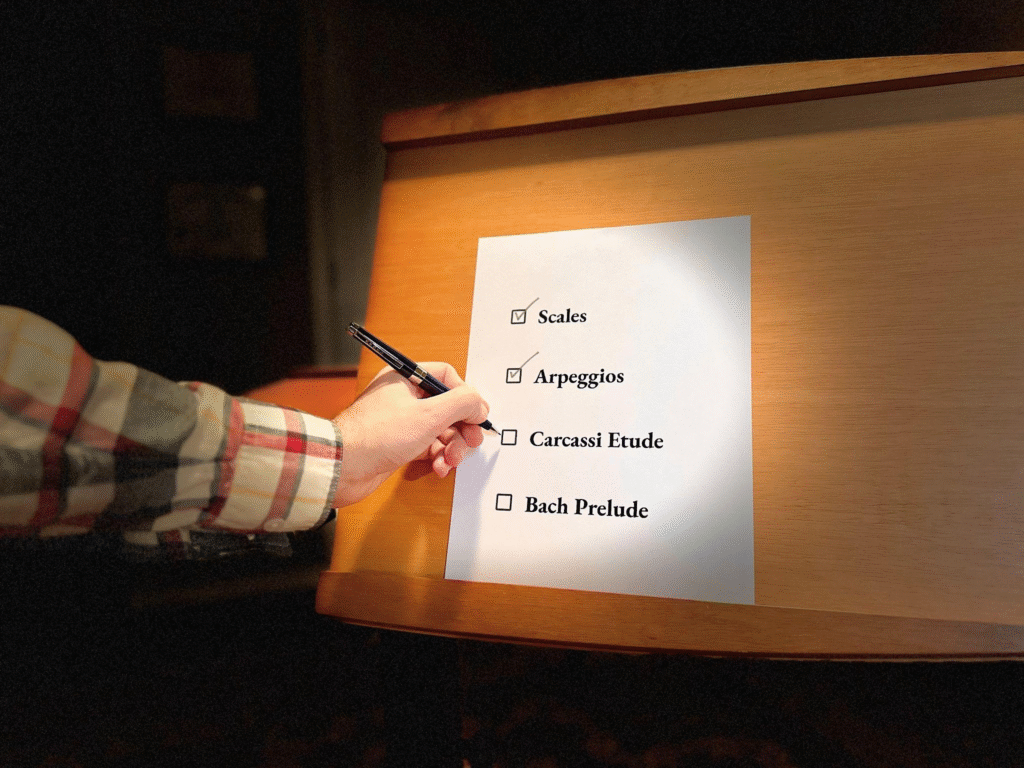
Make the first five minutes your warmup time. Perhaps play a couple scales, practice easy repertoire, or whatever is appropriate for you and your instrument.
Then, you can make the next five minutes technique practice, dedicating your time to adjusting small details in how you play your instrument or sing so that you become even more precise and more efficient in your motions. Then continue thinking about this as you move on to repertoire.
Make the next ten minutes your time to practice one of your pieces, and then wrap up with ten minutes on a different piece. Now, you may need to spend more or less time on a certain piece depending on how new it is and the difficulty level. That means that for some people you may need even less time to practice than 30 minutes. Perhaps you are a total beginner and 30 minutes would be quite a long practice period. Maybe you have been playing for over five years and you have quite ambitious goals on your instrument. You would likely need more than 30 minutes. When I was at my personal peak of musical dedication, I spent 6 hours each day practicing! That was basically all of my free time when I was in college.
- Identify a Precise Goal Before Everything You Play
While being precise in how you schedule your practice is a great start, you still won’t be as effective as possible if you don’t set a goal for yourself before everything you play. And I mean everything! Every single note, every passage of a piece, or full run-through of a piece should be preceded with a specific goal, if not several specific goals.
For example, you could say “I will play measures 17-20 of Bach’s Prelude with 100% correct fingers and notes, and with a crescendo through all of the measures.” Then, it’s up to you to choose a speed where all of these goals can be accomplished immediately. Don’t postpone having strict goals for a later time. Start every piece with these goals in mind, and have a goal for everything you play for that entire 30-minute practice session.
- Be Very Strict!
Music is a discipline that favors those who have discipline. If you are a strict and demanding person towards yourself and your own behaviors, you will find natural success in music. When I was younger, I was not that person. I was far too relaxed, and it showed in the quality of my musical performances. I was never able to make everything as tight as it needed to be.
However, by being very honest with myself about the quality of my own playing, and by implementing the strategies discussed in this article, I was able to increase the quality of my performances through high-quality practice and intense discipline.
The key to success in music is consistency in your approach. You have to be consistent in your practice by choosing to pick up your instrument as frequently as you can. Then once that instrument is in your hands, it’s up to you to make every moment count with a maximal level of detail and thought in how you spend your time.
It’s a lot to think about! But you will adapt quickly to this style of practice if you commit yourself to it.